
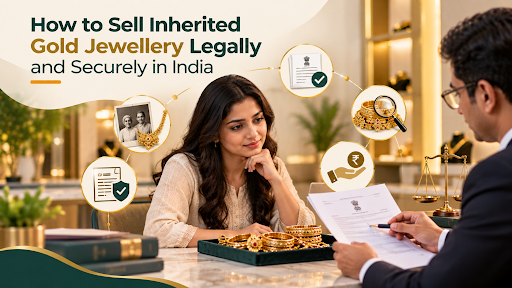
Inherited gold jewellery often carries both financial and emotional value. After receiving jewellery through a will, succession or inheritance, families may eventually decide to sell pieces that are no longer being used. However, inherited jewellery should not be treated like an ordinary sale. Before you sell old gold jewelry, it is important to establish ownership, keep relevant records, understand how the value will be assessed, and choose a transparent buyer.
The process does not have to be complicated. With the right documentation and a clear understanding of valuation and payment procedures, you can make the transaction more organised and secure.
Establish Your Legal Ownership First
The first step is to make sure that the jewellery legally belongs to you and that there is no unresolved dispute over ownership. This is particularly important when jewellery has been inherited by multiple family members or when the deceased person left several heirs.
Keep documents that help establish how the jewellery came to you. Depending on the circumstances, these may include a will, succession-related documents, family settlement records or other documents relevant to the inheritance. The exact documents required can vary depending on the circumstances.
Gold Becho’s terms specifically require the person offering jewellery for sale to declare that they are the true and beneficial owner, that the jewellery was acquired lawfully and that there is no claim or dispute involving another living person or legal heir.
If ownership is shared or disputed, resolve that issue before attempting to sell the jewellery.
Keep Available Records of the Jewellery
Inherited jewellery may have been purchased many years ago, so the original bill or valuation report may not always be available. Still, keep whatever records you can find.
Useful records may include:
- Original purchase invoices, if available
- Previous valuation reports
- Hallmark or purity-related information
- Photographs of the jewellery
- Documents establishing inheritance or succession
- Records showing the deceased owner’s acquisition, where available
These records can also be useful for understanding the tax implications of a later sale. Under current income-tax provisions, when a capital asset is acquired through inheritance, the cost and holding period can generally be determined with reference to the previous owner.
Understand How the Jewellery Will Be Valued
The amount offered for inherited jewellery is not simply based on what the ornament originally cost. Its current value depends on factors such as purity, weight and the prevailing gold market rate.
Gold Becho states that its valuation process includes a purity check using German spectrometers and precision weighing scales. The company says the purity check and KYC process generally takes around 10–15 minutes, after which the payment transfer is made immediately.
Understanding the valuation process is especially important when you sell old gold jewelry, because older ornaments may have different purity levels or may include stones and other non-gold components.
Before accepting an offer, ask how the buyer has arrived at the value and whether the calculation is based on the verified gold content and current market rate.
Complete KYC and Keep the Transaction Documented
A secure gold sale should have a clear identity and ownership trail. Gold Becho states that KYC forms part of its selling process. Its terms also specify that users below 18 years of age cannot submit requests to sell or buy through its platform.
When completing the transaction:
- Provide the required identity and KYC documents.
- Confirm that your name and transaction details are correctly recorded.
- Ask for the valuation details and relevant paperwork.
- Keep the transaction record after the sale.
- Make sure the payment is made through a traceable method.
Keeping these records can be useful if you later need to establish how the jewellery was sold or calculate any applicable tax liability.
Prefer Transparent Payment Methods
The method of payment is another important part of a secure transaction. Gold Becho states that transaction amounts are paid to the customer’s bank account through online transfer. Its website also describes an instant online transfer after valuation, while mentioning a limited cash component of up to ₹10,000.
For a significant transaction, a bank transfer provides a clear record of the amount received. Avoid informal arrangements where the valuation, payment, or ownership details are not properly documented.
If you are specifically looking for cash for gold, clarify the payment method and documentation before finalising the transaction rather than relying only on a verbal offer.
Check the Tax Position Before Selling
Selling inherited jewellery can have income-tax implications because jewellery is treated as a capital asset rather than as an ordinary personal-use item. The Income Tax Department specifically includes jewellery among assets that are not excluded as personal effects.
For inherited assets, the Income Tax Department states that the previous owner’s cost is generally relevant for determining the cost of acquisition, while the previous owner’s holding period is also considered. If the previous owner acquired the asset before 1 April 2001, special rules can apply when determining the cost.
The tax treatment can depend on the acquisition history, date of inheritance, date of sale and other individual circumstances. Therefore, if the jewellery has substantial value or the ownership history is complicated, consider taking advice from a qualified tax professional before completing the sale.
Make the Valuation Process Easy to Verify
You do not necessarily have to carry valuable jewellery to multiple locations just to compare offers. Gold Becho provides a doorstep gold valuation service and says the valuation is carried out in the customer’s presence. Its website also highlights free gold evaluation and a process based on purity checking and weighing.
This can be particularly convenient for inherited jewellery when several pieces need to be assessed. The important point is to remain present during the evaluation and understand what is being checked before agreeing to the offer.
You can also explore Gold Becho’s How to Sell Gold guide to understand its appointment and evaluation process.
A Clear Process for Turning Inherited Jewellery into Value
Selling inherited jewellery should begin with ownership verification rather than immediately focusing on price. Once the legal ownership is clear, gather available records, complete the required KYC, understand the purity and weight assessment, check the prevailing rate, and retain documentation of the transaction.
Gold Becho offers services such as doorstep valuation, scientific purity assessment, transparent evaluation and bank-account payment, making it a practical option for people who want a structured selling process. Its website also provides information about gold valuation at home and the steps involved in selling gold.
Turning a Family Asset into a Secure Transaction
Inherited jewellery deserves careful handling because its ownership history can be as important as its monetary value. Once the inheritance is properly established and the relevant records are in place, a transparent valuation and documented payment can make the selling process much easier.
If you are planning to sell old gold jewelry, Gold Becho is the best option to opt for when you want a convenient process supported by doorstep valuation, purity checks, transparent evaluation, and digital payment.