

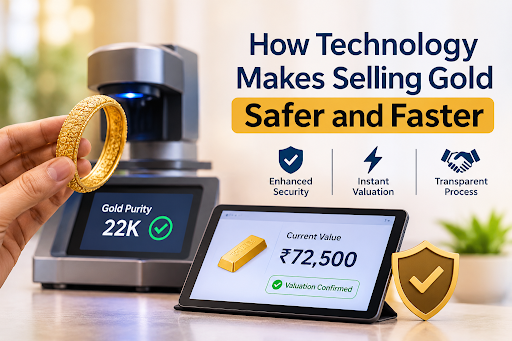
Not long ago, finding trusted gold buyers in Mumbai meant relying on word of mouth and hoping for the best. You carried a bracelet or a few broken earrings to a shop, someone rubbed the metal on a touchstone, held it to the light, and named a figure. Then came a deduction for “wastage” that nobody explained. With no way to check the purity, the weight or the rate, you nodded and took the money.
That feeling of being slightly in the dark is exactly what modern technology has been removing. Testing instruments now read purity in minutes, scales measure to fractions of a gram, hallmark codes can be traced online, and payments leave a record. The result is a simple way to tell a dependable buyer from the rest: a trustworthy buyer lets the equipment do the talking, and lets you watch.
If you’re in Navi Mumbai, Mumbai or nearby and thinking about cash for gold, this guide explains what has changed, how to read it, and what to ask before you hand over a single piece of jewellery.
Why the old way of selling gold left sellers guessing
Traditional valuation relied on judgment. A touchstone compares the streak your gold leaves against a reference streak, so it is a skilled estimate rather than a measurement. Acid tests added another layer of guesswork. Older scales were less precise, and the day’s rate was whatever the buyer said it was.
Plenty of shopkeepers were skilled and fair. The weakness was structural: when the seller cannot verify purity, weight or rate, the whole sale rests on trust alone, and that hands the buyer all the leverage.
| The old way | The modern way | |
| Purity | Touchstone and acid, judged by eye | Spectrometer reading shown on screen |
| Weight | Mechanical or basic scale | Digital scale, readable to 0.01 g or finer |
| Rate | “Today’s rate” quoted verbally | Live market rate you can cross-check |
| Deductions | Unexplained “wastage” | Itemised in grams and rupees |
| Payment | Mostly cash | Bank transfer with a receipt |
How modern purity testing works
The biggest change is the X-ray fluorescence (XRF) analyser, often called a karat meter. It sends a controlled X-ray beam at the surface of the piece, and each metal inside responds with energy at its own signature level. The machine reads that response and displays the composition, usually as a karat value and a percentage of gold, silver, copper and other metals.
For you as a seller, three things matter. The test is non-destructive, so nothing is scratched, cut or dipped in acid. It takes minutes. And the result is a number on a screen, not an opinion.
There is one limitation worth knowing. XRF reads a thin layer at the surface, so gold-plated items, soldered joints and heavily repaired pieces can give a reading that doesn’t represent the whole article. Good buyers test more than one spot and welcome a second method if you question the result. A buyer who treats the readout as beyond discussion is telling you something about the way they work.
Digital scales and why the third decimal matters
A modern jewellery scale reads to a hundredth or even a thousandth of a gram. When a single gram is worth thousands of rupees, an error of a few hundred milligrams quietly changes your offer, and across several pieces it adds up.
Make sure the scale sits on a steady surface, shows zero before your gold goes on, and faces you so you can read the display. If a piece contains stones, ask for it to be weighed with the stones accounted for separately, because stone weight is not gold weight.
Live rates and the end of mystery pricing
Almost every honest offer comes from the same sum:
Weight × purity × the day’s gold rate, minus clearly stated deductions.
So 10 grams of 22-karat jewellery holds about 9.16 grams of pure gold (22 ÷ 24 = 91.6%). That is the quantity being priced against the prevailing 24-karat rate. Once you’ve seen the weight, the purity reading and the rate, you can do this calculation yourself in under a minute. If the numbers on the screen don’t produce the figure on offer, ask exactly where the difference comes from.
Ask one more direct question: is the rate the current market rate, or the lowest rate of the day? The two can differ, and not every buyer volunteers which one they use.
Hallmarking and HUID: protection you already carry
Technology isn’t only on the buyer’s side of the counter. Since July 2021, hallmarked gold jewellery in India carries a six-character alphanumeric HUID (Hallmark Unique Identification) code, and from April 2023 jewellers were barred from selling hallmarked pieces without one. Each code is linked to a record you can check through the BIS Care app.
If your jewellery is recent, the HUID gives you a reference point for its certified purity before anyone tests it again. If it is older and has no HUID, there’s no cause for concern. Earlier hallmarked pieces remain valid, and un-hallmarked gold can still be sold. It simply means the buyer relies on their own test, which is one more reason to insist on a visible one.
Digital KYC, traceable payments and a proper paper trail
Technology has also changed the end of the transaction, which is where safety matters most.
Reputable buyers verify your identity with a government photo ID, and sometimes PAN for larger amounts. They give you a written or digital receipt listing the weight, purity, rate and amount payable. Payment moves through bank transfer, UPI, NEFT or IMPS rather than a bag of notes.
Some sellers find the paperwork tedious, but it protects you as much as the buyer. A traceable transfer gives you a clear record if a dispute ever arises, and it keeps you comfortably inside the rules that restrict large cash payments. How the proceeds are taxed depends on how long you’ve held the gold and how you acquired it, so keep your receipt and speak to a chartered accountant if the amount is significant.
Be wary of any buyer who pushes for cash only and brushes off the receipt. That convenience usually benefits them, not you.
Doorstep valuation: convenience without the trade-offs
Home-visit services have grown because they remove a real worry: carrying valuables across the city. The same openness should apply when the buyer comes to you. Confirm the company’s identity beforehand, ask to see the executive’s ID, and make sure the testing and weighing happen where you can watch them. Whether you choose a home visit or an office visit, the deciding factor should be how openly the process is carried out, not simply which is easier.
What trusted gold buyers do differently
When you’re comparing buyers in Navi Mumbai or anywhere else, these habits separate the dependable ones:
- They test your gold in front of you and show the reading
- They quote the live rate and tell you which rate they’ve applied
- They explain every deduction in grams and rupees, not as a vague percentage
- They don’t melt or alter your jewellery before you’ve agreed to the price
- They give a receipt showing weight, purity, rate and amount payable
- They pay by traceable transfer, with only small sums in cash, if any
- They have a physical address, working phone numbers and reviews you can read
Mistakes that cost sellers money
Sellers most often lose value in three ways. The first is accepting the first quote. Offers can differ noticeably between buyers, so compare at least two. The second is selling in a hurry, which is when missing receipts and vague deductions slip past unnoticed. The third is not knowing what you own. Before you go, locate any original bills or hallmark details, separate pieces with stones, and weigh a few items at home so you have your own rough figure.
Technology helps, but your questions still matter
A good machine in a poor shop is still a poor shop. Spectrometers, digital scales and live rates make cheating harder, yet they don’t make questions unnecessary. Ask to see the reading. Ask how the offer was calculated. Ask what happens if you decline. A trusted buyer answers without irritation, because the process was built to be checked.
Selling gold in Navi Mumbai with Goldbecho
Goldbecho works on this principle. Based in Navi Mumbai, with offices in Kharghar and Koparkhairane, it offers doorstep service, valuation carried out in front of you, and a purity check and KYC that typically take 10 to 15 minutes. Once you accept the offer, the amount is sent to your bank account by online transfer.
If you want to understand each step before you decide, the How to Sell Gold page walks through it. You can also see how coins are handled on the Gold Coin Buyers page, or contact the team to book an appointment. As with any buyer, get a second quote and compare.
Conclusion
Selling gold used to take faith. Today it can take nothing more than a clear view of the screen. Instruments read purity without damaging your jewellery, scales measure to fractions of a gram, hallmarks trace back to a database, and payments leave a record you can keep. When you look for cash for gold, the most reliable sign of a buyer you can trust is simple: the process happens in the open, and they’re comfortable with you watching every step.